Skip to content
Sela Developments

EIFS Installation and Repair in Calgary

EIFS (exterior insulation and finish system) is a cladding made of foam insulation board fixed to the wall, a base coat with embedded reinforcing mesh, and a textured acrylic finish. It is often called synthetic stucco. Sela Developments installs and repairs EIFS in Calgary on commercial and residential buildings, including impact punctures, woodpecker holes, cracked base coats and failed sealant joints. Under the National Building Code, Alberta Edition, EIFS on houses and small buildings needs a drainage cavity at least 10 mm deep behind the board.

Layers
Insulation board, base coat with mesh, finish coat
Code path (houses and small buildings)
NBC(AE) Subsection 9.27.14 and CAN/ULC-S716.1, S716.2, S716.3
Drainage cavity
At least 10 mm deep, open area at least 13% of a full-size panel
Ground floor mesh (Dryvit)
Panzer 15 or Panzer 20 (509 or 695 g/m²) under standard mesh
Patch mesh lap (Dryvit)
About 64 mm (2 1/2 in) onto the existing base coat
Work we do
New EIFS, impact and woodpecker repairs, sealant joints
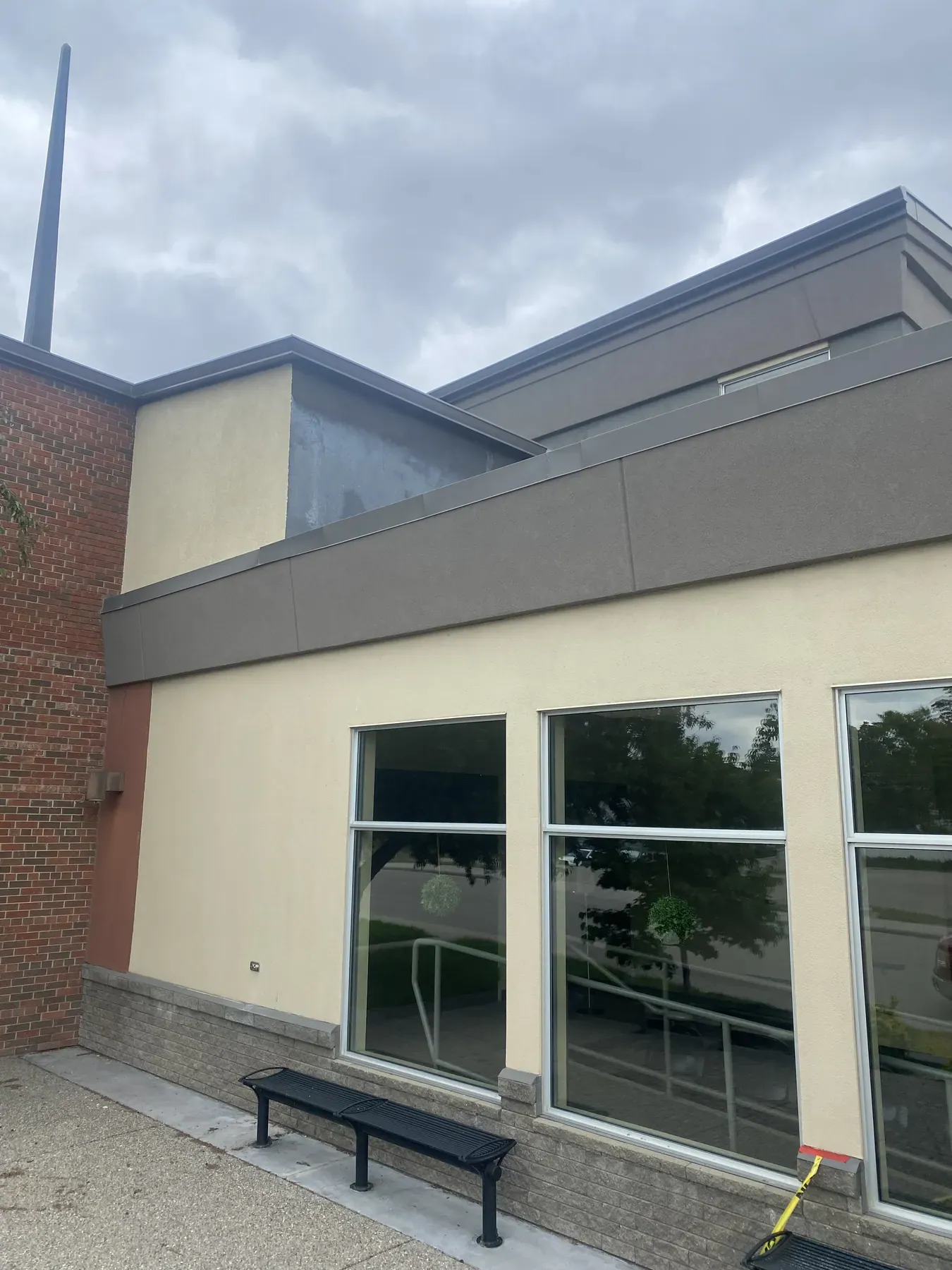
Church entrance with cream EIFS walls, a grey EIFS fascia band, brick piers and tall windows
Church entrance with EIFS walls and a contrasting EIFS fascia band.

01 · Overview

What EIFS is and where it is used in Calgary

EIFS is a cladding system that puts insulation on the outside of the wall and finishes it with a thin, hard coating. It is built in layers:

  1. Water-resistive barrier. On drainage systems, a membrane on the sheathing with a drainage cavity in front of it.
  2. Insulation board. Foam board such as expanded polystyrene (EPS), fixed with adhesive or fasteners.
  3. Base coat with reinforcing mesh. A trowelled base coat with glass fibre mesh embedded in it. The mesh weight sets the system’s impact resistance.
  4. Finish coat. A textured acrylic finish that carries the colour.

On houses and small buildings, the National Building Code, Alberta Edition covers EIFS in Subsection 9.27.14. That subsection applies to systems that meet CAN/ULC-S716.1 and have a geometrically defined drainage cavity at least 10 mm deep, with an open area of at least 13% of a full-size panel. Design must follow CAN/ULC-S716.3 and installation CAN/ULC-S716.2. Any EIFS outside those limits has to comply with Part 5, the engineered design path.

In Calgary you will find EIFS on plazas, churches, offices, apartment buildings and newer infill homes. As an EIFS contractor, Sela Developments installs new systems and repairs existing ones on both commercial and residential buildings.

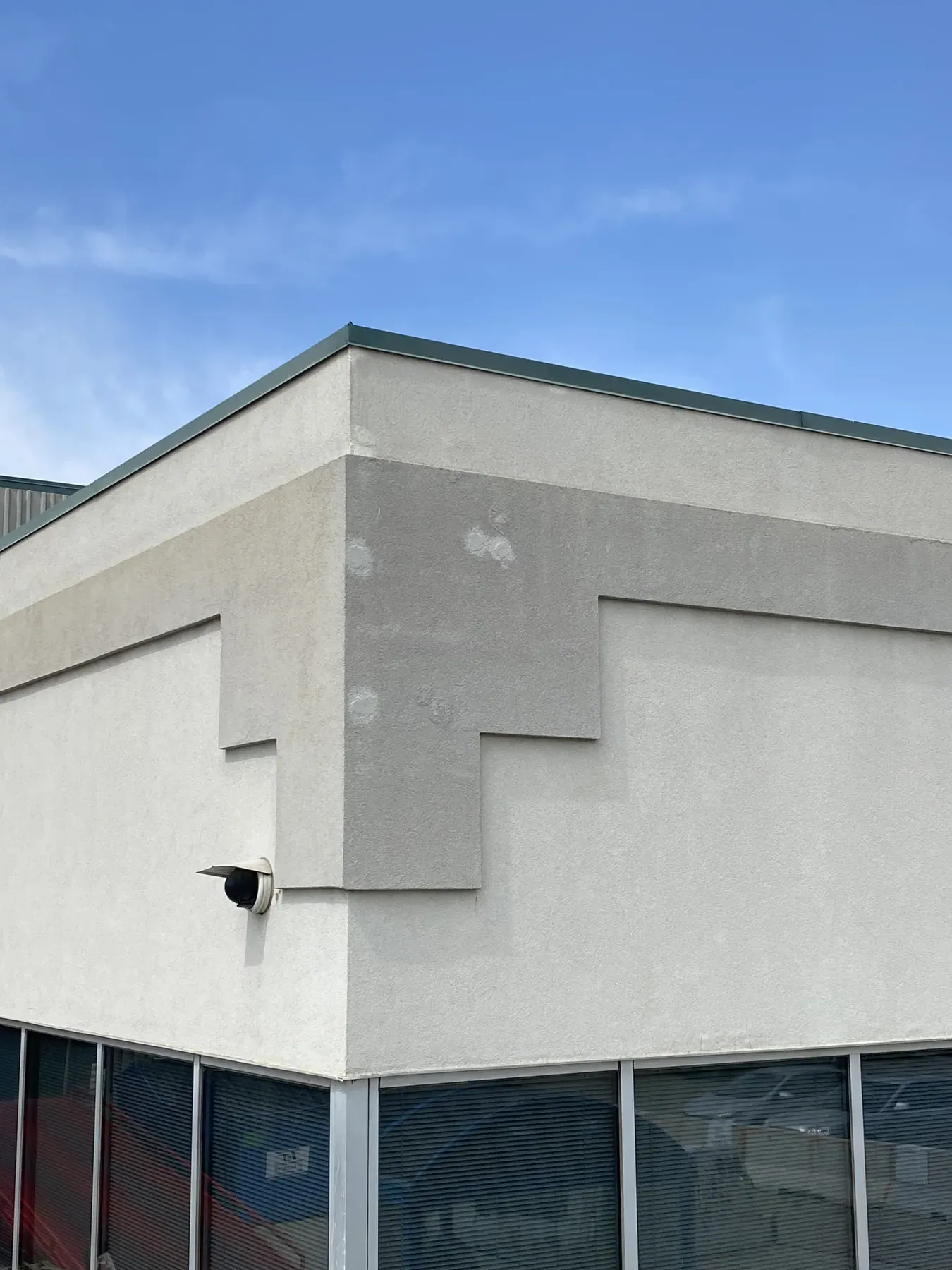
Light grey EIFS cornice on a commercial plaza corner with visible patched spots above the storefront windows

02 · Before you start

What goes wrong with EIFS walls

These are the four problems we look for on every EIFS wall.

01

Drainage EIFS or barrier EIFS?

Barrier EIFS has no drainage plane behind the foam. Dryvit describes it as relying on sealant joints and flashings to keep water out. Drainage EIFS adds an air and water-resistive barrier behind the insulation so incidental water can drain away. Older buildings may have barrier systems, and any leak at a joint goes straight to the sheathing.
How we handle it
02

Impact damage near the ground

The base coat and finish are thin. Near grade, around doors and along walkways, carts, ladders, balls and vehicles can punch through to the foam.

How we handle it
03

Woodpecker holes

Northern flickers dig into EIFS. Walls and Ceilings, citing the Calgary Herald, reported in June 2026 that some Calgary exterior contractors were receiving more than 50 flicker damage calls a week, nearly double typical volumes, and that the problem was particularly severe on synthetic stucco homes.

How we handle it
04

Sealant joints and maintenance

Every EIFS wall has sealant where it meets windows, doors, other materials and expansion joints. Sealant is the part of the wall that weathers out and needs replacing. When it splits or pulls away, water gets behind the finish.

How we handle it
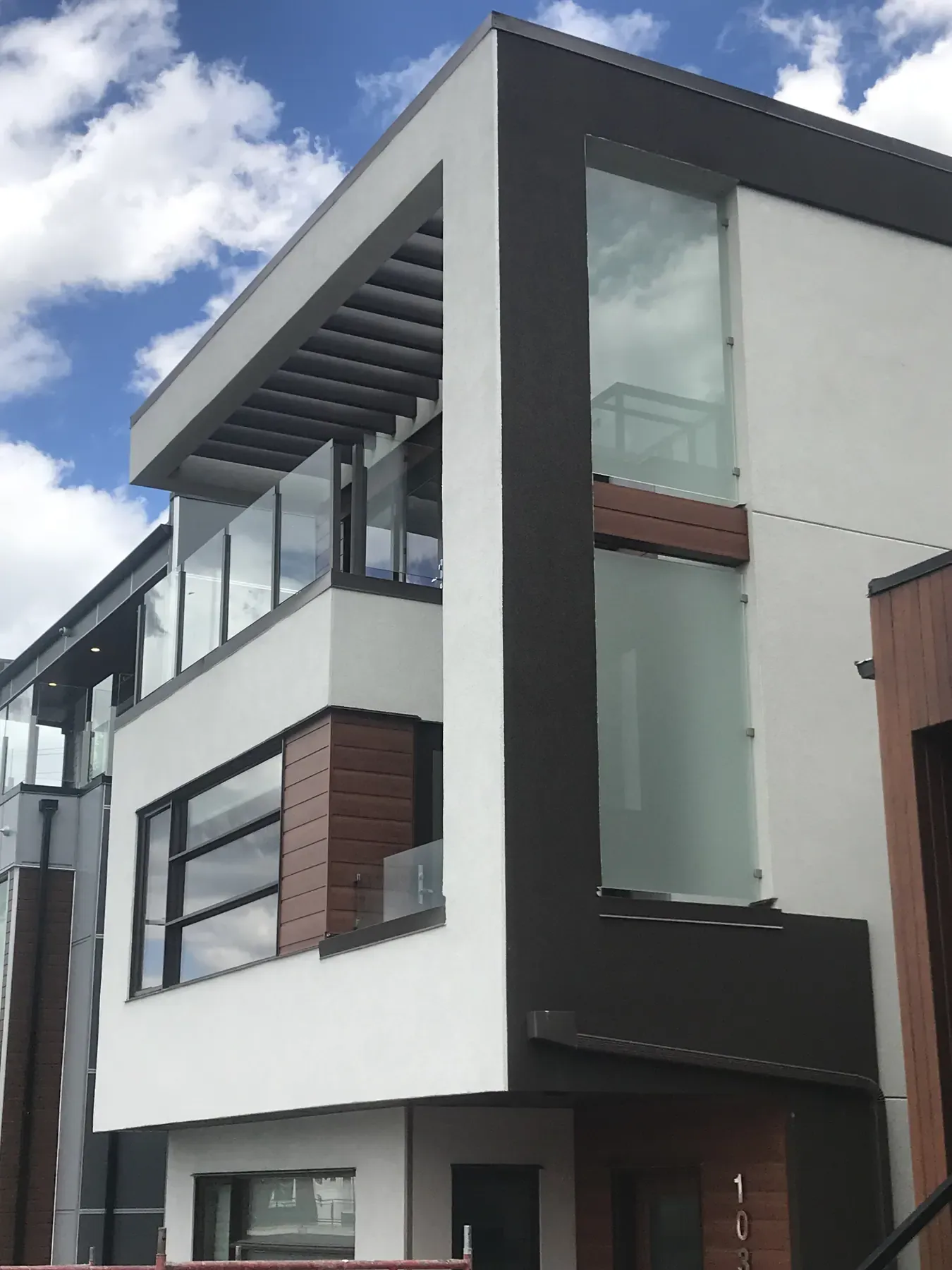
Three-storey modern infill with white and charcoal smooth wall finishes, wood accents and glass balcony railings

03 · Key insight

EIFS is a thin hard shell over soft foam, so the shell is the whole defence

From the street, EIFS and acrylic stucco look alike. The difference is what is behind the finish. Stucco is at least 15 mm of cement over lath. EIFS is a relatively thin layer of base coat and finish over foam, which is why birds can dig into it and why impacts near the ground break through.

That shell is the system’s protection against water and impact. A single hole lets water into the foam and, on barrier systems, onto the sheathing. A failed sealant joint does the same along its whole length. So EIFS lasts when the shell is kept closed: the right mesh where impacts happen, holes fixed when they appear, and sealant replaced before it fails.

04 · How we work

How we install and repair EIFS in Calgary

  1. Answers 01Drainage EIFS or barrier EIFS?

    We install drainage EIFS to the CAN/ULC-S716 standards

    New EIFS on houses and small buildings goes on as a drainage system that meets Subsection 9.27.14: a water-resistive barrier on the sheathing, a drainage cavity at least 10 mm deep, and materials that conform to CAN/ULC-S716.1. On larger commercial buildings, we install the system the architect or engineer has specified under Part 5. When we repair an older barrier system, we tell you what that means for the wall and price a drainage upgrade separately if the damage warrants it.

  2. Answers 02Impact damage near the ground

    We use heavier mesh where impacts happen

    Mesh weight sets impact resistance. Dryvit’s mesh range runs from standard mesh at 4.3 oz/yd² (146 g/m²), through intermediate mesh at 12 oz/yd² (407 g/m²) for second storeys with moderate traffic, to Panzer 15 and Panzer 20 at 15 and 20.5 oz/yd² (509 and 695 g/m²). Dryvit recommends the Panzer meshes for all ground floor and high-traffic areas, installed under the standard mesh. We mark high-impact zones on the plan before the base coat goes on.

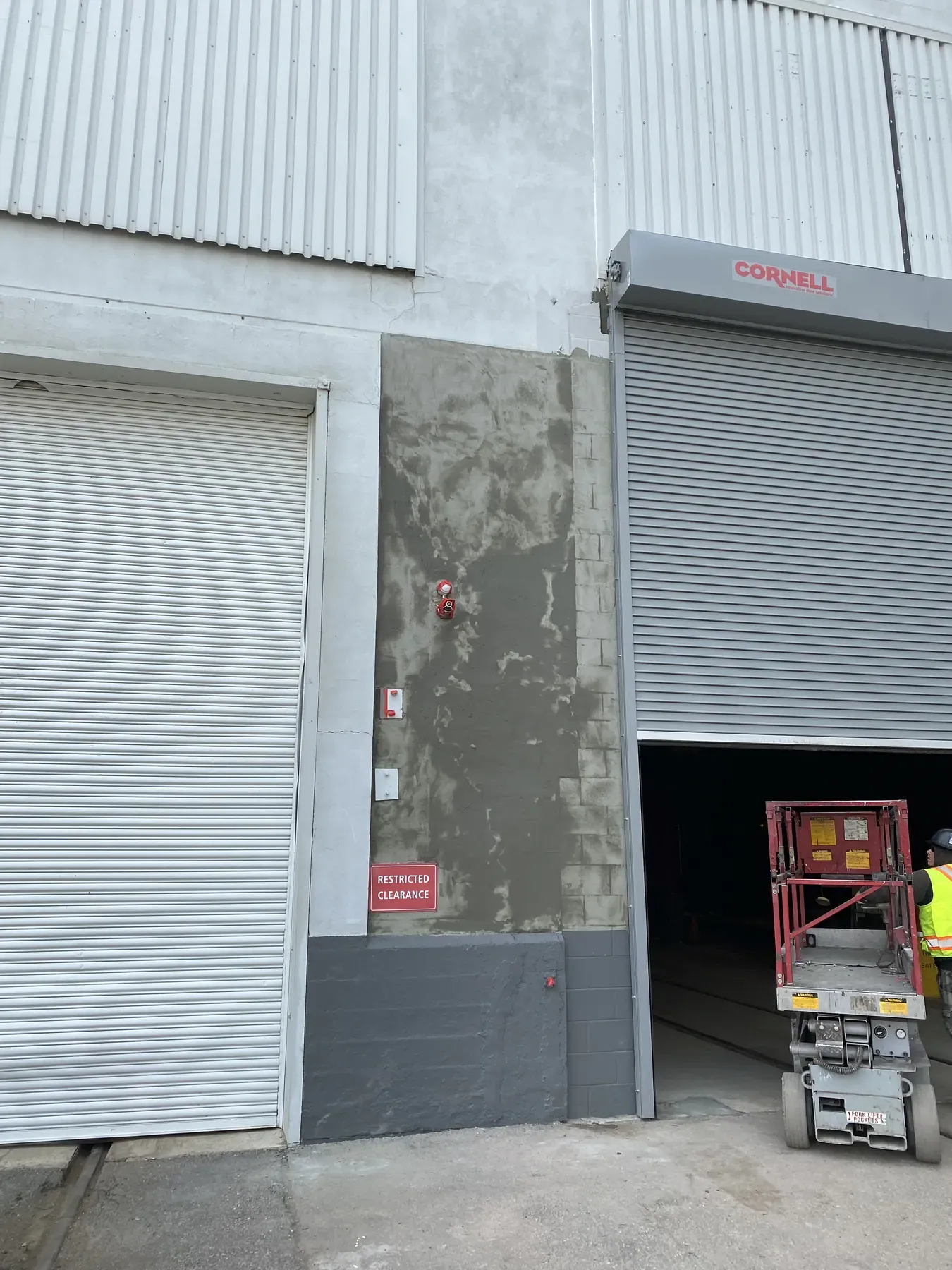
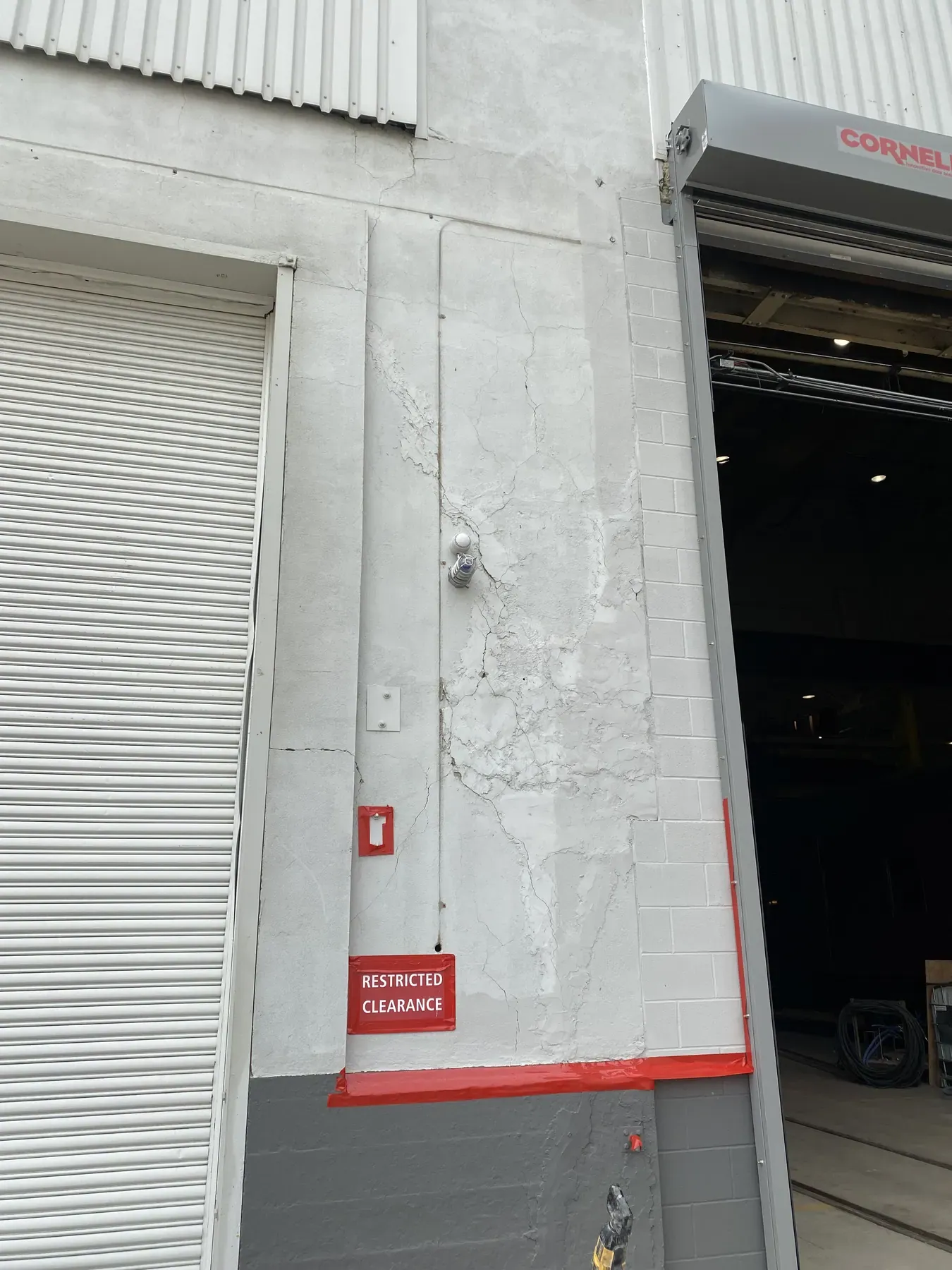
    Cracked and broken wall finish between two overhead doors on an industrial building, before repair
  3. Answers 03Woodpecker holes

    We cut out and rebuild punctures and woodpecker holes

    For impact and woodpecker damage we follow the manufacturer’s repair procedure. Using Dryvit’s as the example: cut the damaged area out to the substrate, fit new insulation, grind the surrounding finish back at least 3 in (76 mm) to expose the base coat, then apply new base coat and mesh lapped about 2 1/2 in (64 mm) onto the old. After at least 24 hours of drying, the new finish goes on and is blended into the texture. For colour, Dryvit recommends a final coat over the whole wall. Where flickers keep returning, wildlife specialists recommend prompt repair together with netting or metal barriers.

    The same industrial wall after a new base coat patch, with a scissor lift at the open overhead door
  4. Answers 04Sealant joints and maintenance

    We cut out and replace failed sealant joints

    Following Dryvit’s sealant joint procedure, old sealant is cut out completely and the joint edges are cleaned. Damaged mesh at the joint is repaired with new mesh lapped at least 2 1/2 in (64 mm), and the edges are primed and left to dry at least 72 hours. Then a closed cell backer rod, primer and sealant go in. The code requires sealant between cladding and window and door frames and at joints between different cladding materials, using sealants such as those meeting ASTM C920, with backer rod meeting ASTM C1330.

05 · In short

EIFS in Calgary, repaired before small holes become wet walls

EIFS in Calgary is foam insulation covered by a thin, mesh-reinforced shell, and it lasts when that shell stays closed: drainage behind it, heavy mesh near the ground, holes repaired promptly and sealant joints replaced on time. Sela Developments installs drainage EIFS to CAN/ULC-S716 and repairs impact damage, woodpecker holes and sealant joints on commercial and residential walls.

If you want a heavier, masonry finish instead, compare EIFS with natural and manufactured stone veneer. For a full recladding, see exterior renovations in Calgary, and for plazas and other commercial buildings, see commercial contracting. Then send us photos of the damage and we will come and look at it.

Sources

6 cited

Last reviewed October 22, 2026 by the Sela Developments team. See our editorial policy for how we write and check these pages.

FAQ

Questions we get asked

Short answers to what owners ask us most. Something else? Ask us directly.

What is the difference between EIFS and stucco?

Traditional stucco is a cement plaster at least 15 mm thick trowelled over wire lath. EIFS is a foam insulation board covered with a thin, mesh-reinforced base coat and an acrylic finish. From the street the two can look alike. At an edge, a hole or a utility penetration the difference shows, because EIFS has foam behind the finish and stucco has cement and wire lath.

Why do woodpeckers make holes in EIFS?

Northern flickers are drawn to a thin exterior finish over foam insulation, which is easy to dig into and suits nesting. In June 2026 Walls and Ceilings, citing the Calgary Herald, reported a surge in flicker damage across Calgary that was particularly severe on homes clad with synthetic stucco. Wildlife specialists quoted in the report recommend prompt repair of holes and physical exclusion such as netting.

Can EIFS impact holes be repaired without redoing the wall?

Yes. The damaged area is cut out to the substrate, new insulation is fitted, and new base coat and mesh are lapped onto the sound base coat around it before a new finish goes on. Dryvit's procedure laps the new mesh about 2 1/2 in (64 mm) and lets it dry at least 24 hours before finishing.

What maintenance does EIFS need?

Walk the walls regularly and look for cracks, holes and sealant that has split or pulled away, and fix them while they are small. Dryvit advises cleaning with a low-pressure washer under 500 psi held at least 12 in from the surface, avoiding acidic cleaners, and recoating only with a breathable acrylic finish, never oil-based paint.

Is EIFS used on commercial buildings in Calgary?

Yes. You will find EIFS on Calgary plazas, offices, churches and multi-family buildings, often as cornices, bands and large wall areas. On larger buildings, or where a system falls outside the Part 9 rules, the code requires the wall to be designed under Part 5, usually by an architect or engineer. We build and repair to those drawings.

Get an EIFS repair or installation quote

Send photos of the damage or the wall, the building address and how high the work is. We assess the system, find out what is behind the holes, and quote the repair or the new cladding in writing.